 Sign in
VPS Hosting Companies: What Separates a Good One From the Rest
VPS hosting companies all sell similar looking plans, but they differ in support, terms, transparency and how they handle problems. This guide explains how the market works and what to check, so you can decide where to buy VPS hosting without relying on someone else's top list.
Why top lists are not much help
Search for the best VPS hosting companies and you will find endless rankings. Many are paid for through referral commissions, which means the order can depend on who pays the most. Few of them test every provider in your location, with your software, over a long period. Even an honest list can only rank companies for an average buyer, and you are not an average buyer.
That is why this guide does not name or rank companies. A far better use of your time is learning what to look for, because a simple set of checks will serve you whenever you buy a server, including years from now when today's lists are out of date.
What VPS hosting companies actually sell
Under the marketing, a VPS company sells a slice of a physical machine plus the network, power, support and software that keep it running. Companies in this market vary in how they are put together, and that shapes your experience:
None of these is automatically better. What matters is whether the model fits how you want to work. Someone who wants to deploy through an API has different needs from someone who wants a prompt reply when a server will not boot.
- Self service clouds: usually built around an API and a dashboard, with a long menu of services. Great if you like building things yourself, less so if you want a person to help.
- Traditional hosts: usually focus on fixed monthly plans and direct support. Often simpler to understand.
- Resellers: sell capacity rented from another firm. This can work well, but it can add a layer between you and whoever fixes the problem.
- Niche specialists: focus on a particular audience, such as traders, developers or a single country.
The real differences between companies
When plans look alike, these are the factors that separate one company from another.
Transparency. A good company states clearly what you get: what the processor is, whether memory is guaranteed, how traffic is counted, what renewal costs. If you have to hunt for that information, take it as a sign.
Support. Check the hours, the ways of getting in touch, and what falls within scope. Managed and unmanaged mean very different things. On an unmanaged plan, support looks after the server platform, while the software inside it is your responsibility.
Terms of service. Read what is prohibited, how suspensions work, and how refunds are handled. The acceptable use policy matters most if your project is anything unusual.
Locations. A company with many locations gives you more chance of placing a server near your users, and more options as you grow.
Billing flexibility. Look at the choice of terms and payment methods. Monthly billing lowers your risk, and accepted payment methods matter if you are buying from outside the main card markets.
Control. Full root or admin access, the operating systems on offer, and whether you can reinstall on your own all affect how much you can do without opening a ticket.
Speed of delivery. Being able to get a working server in minutes is valuable when a project is waiting.
Questions to ask before you pay
A short email or chat before buying tells you a lot. Consider asking some of these:
Pay attention to how the answers feel as well as what they say. A clear, direct reply, sent within a reasonable time, is a useful preview of what support will be like later on.
- Is the memory on this plan guaranteed, or can it be shared?
- How is traffic measured, and what happens if I go over?
- What happens to the price when my first term ends?
- Which location would you suggest for users in my country?
- Is the IPv4 address dedicated to my server?
- What are your support hours, and who handles hardware faults?
- How are backups handled, and are they my responsibility?
- What is your refund policy, and how do I cancel?
Warning signs to take seriously
Be careful if a company shows several of these signs:
Any seller can have a bad day, but several of these together suggest you should move on.
- No clear contact information or terms of service
- Prices that only appear after you begin checkout
- Vague claims with no details behind them, such as unlimited everything
- Pressure to take a long term straight away, with no short term option
- Reviews that are all glowing, in very similar language
- No answer to a simple pre sale question
How to compare your shortlist
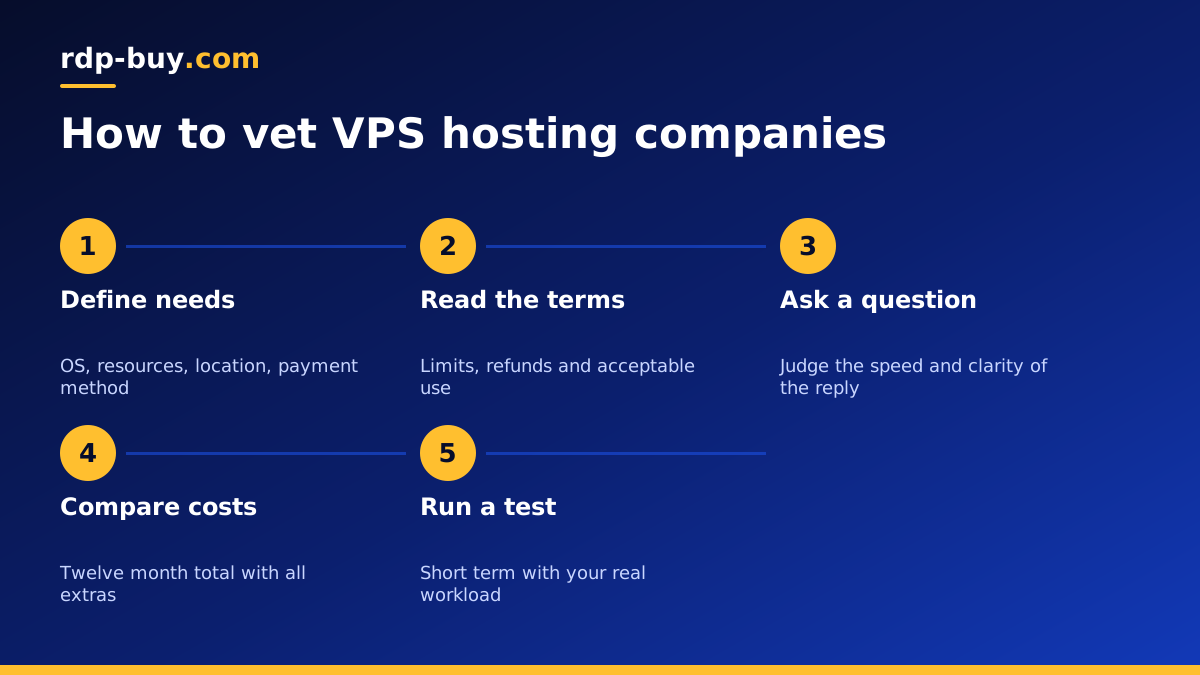
Once you have two or three candidates, put them side by side on paper. Start with your needs, and remove anything that does not fit. Then work out what each costs over a full year, including extras, using the method in our VPS price comparison guide. Our checklist for comparing VPS providers is also useful for looking at non price factors. If forum opinions are part of your research, read how to read VPS advice on Reddit first.
Do not be tempted by features you will not use. A long list of cloud services means nothing if all you need is one reliable Linux server. Think about who will look after the server too. If that person is you, working evenings, simple plans and clear documentation may be worth more than a dashboard full of options you will never open. Match the company to the time you really have.
Run a short real world test
Nothing replaces trying the service. Take the shortest term you can, deploy your real software, and use it for a few days. While you do that, open one support ticket with a genuine question. Check how the server behaves at busy times, and measure response times from where your users are. Then decide whether to stay and commit to a longer term.
It is also worth checking that your exit is simple. Keep your data portable, take your own backups and avoid building around a single company's special features unless you truly need them. If your server is a standard Linux install, moving later is mostly a matter of copying files and databases.
How rdp-buy.com fits
We would rather you run these checks on us too. Here is exactly what you get from rdp-buy.com: 33 locations, full admin or root access, a dedicated IPv4 address, monthly, half-yearly or yearly billing, 24/7 support, and servers ready in minutes. You can pay by card, PayPal or crypto, and the Windows licence is included in Windows prices. Our server locations page lists every region.
Choosing where to buy
Decide what matters most for your project, and let that pick the company. If it is direct help, weigh support most heavily. If it is a specific country, start with location. If it is a low risk trial, look for monthly billing and clear terms.
When you are ready to compare a plan against your list, see our VPS hosting plans. If you are new to this, our guide on how to buy a VPS for the first time takes you through the whole process.